
We at Radonleaders.org are excited to present our new Blog feature Q&A with Radon state officials. This Q&A will allow states to provide updates with the RL.org community, so as to share the great work that is going on around the nation. In addition, this will assist in providing programs with different approaches in their area and ways to incorporate even greater results with additional efforts. We have developed four topic areas which we want to explore during our Q&A: Rules and Regulations, Partnership, Outreach and Region Meetings.
Patricia W. Smith of the Alabama State Radon Program gave a great project overview at the last Region 4 Radon meeting. She took time out of her endless work schedule to inform us about some of the great work that has been going on in here state. Also, attached you will find her presentation from the meeting.
Partnership:
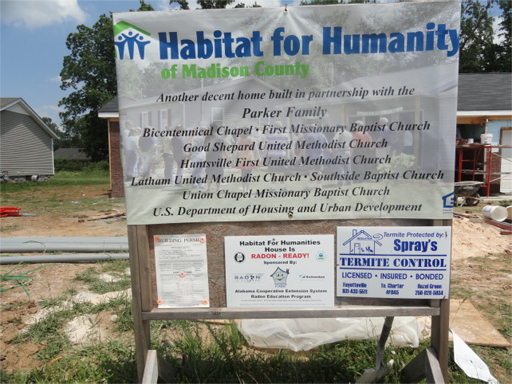
- How did you originally develop a partnership with Habitat for Humanity?
- What was the most rewarding part of working with Habitat for Humanity?
- What was the community’s response towards your efforts in spreading the radon message “Test. Fix. Save a Life” and have they taken up this call and tested?
- Is there a plan to have future collaboration like this between Alabama Cooperative Extension System Radon program and Habitat for Humanity?
- What advice would you give to other States interested in expanding their Radon programming?
The partnership was originally developed with the Huntsville Habitat for Humanity for Madison County by Mr. Walter Rodgers, Madison County Urban Regional Extension Agent in the Madison County Extension System Office. Over the past 2 years Mr. Rodgers and I had talked about making contact with the Habitat for Humanity Organization for Madison County. In July 2010, Mr. Rodgers heard that there were going to be some habitat homes built in Northwest Huntsville, so he contacted Mr. Don Adams, Construction Project Manager for Habitat Humanity for Madison County to talk to him about putting the radon system in the habitat homes.
Mr. Rodgers contacted me as the Alabama State Radon Coordinator and asked if I would give Mr. Adams a call. I called Mr. Adams to introduce myself and asked him if he could make time to meet with us about The Alabama Cooperative Extension System becoming partners with Habitat Humanity for Madison County. Mr. Don Adams said that he would be glad to meet with us and would like to also bring Mr. Ben Steele, the Assistant Construction Project Manager for the upcoming habitat project. Pat Smith made contact with Mr. Dennis Miller, Alabama Certified Mitigator about the Humanity Habitat project to see if he would also become a partner with the Alabama Cooperative Extension System Radon program volunteering to put the radon reduction system in the four homes. The planning meeting was held in September 2011. It was agreed that The Alabama Cooperative Extension System, The Habitat Humanity for Madison County and The Alabama Certified Mitigator would get in partnership and move forward in putting the radon systems in the four habitat homes
To be able to develop a working relationship with the Habitat Humanity for Madison County that was willing to work with The Alabama Cooperative Extension System to ensure that families living in the homes will be safe from breathing this dangerous silent gas known as radon.
The community has received the radon Test. Fix. Save a Life campaign in the 15 Zone 1 counties. Radon displays containing “Consumer Alert! Test. Fix. Save a Life Radon in Alabama” brochures have been distributed in local businesses, churches, medical offices, city hall lobbies, radio stations, hardware stores and public libraries. Citizens have taken up the call and tested their homes as a result of spreading the radon message through the use of radon displays.
There are existing plans to put the radon system in three habitat homes in Franklin County which is a Zone 1 County. The project will be collaboration between Franklin County Extension Office and The Alabama Radon Education Program with the Marian County Habitat for Humanity organization. The habitat homes will be built to replace homes that were destroyed by the April 27, 2011 Tornado devastation in Phi Campbell, Alabama. There are also existing plans to put the radon systems in future habitat homes to be built in Lawrence County by Habitat for Humanity.
Know your community partners that have a common interest with your radon program and then reach out to those community partners.
Outreach:
- What has Alabama found to be the most effective way to spread the message about the issue of Radon?
- What has been the biggest challenge that Alabama has faced in the Radon world and how have you taken steps to overcome that challenge?
- What approaches did Alabama Cooperative Extension System Radon Program and its partners take during 2012 National Radon Action Month to spread the radon message?
- Could you please update us on the success that this year’s efforts have shown thus far?
Alabama believes that the moxt effective way to spread the radon message about radon and its health risks is to have face to face contact with various civic organizations, health fairs/expos, and city council meetings, real estate transaction meetings for new and existing realtors, builders/contractors, medical facilities and media coverage. The Alabama Radon Team motto is “One Opportunity leads to other Opportunities”.
The biggest challenge that the Alabama Radon Education Program faces is to get the public to believe that radon is real. This is because radon is not something that we can see, smell or taste. The most difficult challenge is to get citizens to fix their homes with elevated radon levels. Alabama believes that “One Touch” is vital in bringing people together to bring resources in our Radon communities to continue to produce healthy housing.
The Alabama Radon Education Program in partnership with four Clear Channel radio stations and launched a community engagement project to spread the radon message in (6) Zone 1 Counties.
The Alabama Radon Education Program in partnership with the Florence Alabama Utility Company put the “Radon in Alabama: What You Need to Know” brochures in 48,000 customer monthly utility power bills.
The Alabama Radon Education Program in partnership with the Courier Journal Newspaper placed a post it sticker on the front of the paper. The sticker shaped like a house read: “Consumer Alert! Radon in Alabama Test. Fix. Save a Life. TODAY.” The paper was distributed to 70,000 homes. This can be seen on www.aces.edu/Lauderdale. We believe that the door was open and now ACES is committed to keep the door open as we continue to move the radon message, “Test. Fix. Save a Life,” in our communities.
We have seen an increase in the request for Habitat homes to be built radon-resistant in various counties. There is an increase in the need of builders to receive instruction on building radon-resistant homes as well as cities adopting Appendix F in building codes.
Region Meeting:
- How was your experience presenting at the Region 4 States Radon Meeting and what did you take away from it?
My experience presenting at the Regional IV States Radon Meeting was very gratifying. I found that there was a significant amount of interest in the Habitat for Humanity Project that was done by the Alabama Radon Education Program. I was able to take away from the meeting that there may be some hope that the EPA Federal Action Plan may generate new partnerships for State Programs to continue to share the radon message.
United States