
By Margaret Henderson
Communication with the public to raise awareness and motivate testing for radon and mitigating if needed, takes many forms. From the pedestrian skyways, to traditional media outlets, in malls and on the internet, the Minnesota Department of Health Environmental Health Division raises radon awareness for the residents of the state.
One particularly unique venue for “advertising” radon awareness in Minnesota is the pedestrian skyway system. Boasting the largest pedestrian skyway system in the world, Minneapolis and St. Paul links almost 120 blocks of their downtowns and Duluth and Rochester also have a system. These skyways systems, which are heavily traversed especially in the winter weather, provide an opportunity to present the radon message to individuals making the more than 11 million walking trips each month. For National Radon Action Month in 2012, the Minnesota Department of Health radon staff used this captive audience to promote radon awareness.
Fifty-nine display panels placed in the skyways in 2012 received 250,000 impressions (or views) over the course of a month, and estimated totals are that that as many as 10,490,000 views occurred in the month of January.
Cities and Views:
Minneapolis - 25 panels received 250,000 estimated views.
St. Paul - 11 panels received 165,000 estimated views.
Duluth - 10 panels received 80,000 estimated views.
Rochester - 13 panels received 125,000 estimated views.
Traditional media, such as television, radio and print, also have been effective promoters of the radon concerns in Minnesota. The Indoor Air Unit (Radon Program), in partnership with the Department of Public Safety, produced a short video highlighting the story of one Minnesota family, which was later elaborated upon by the FOX 9 television news. This subsequently resulted in an approximately ten minutes story aired on television and the internet, seen by thousands.
Throughout the years, numerous media outlets have run stories about radon and its risks for Minnesotans. In 2013, local television stations covering the counties of Becker, Brown, Cass, Carver, Clay, Crow Wing, Freeborn, Itasca, Mower, Olmsted, Stearns, Wilkin, Winona and Wright aired radon stories.
Mall billboards have also been effectively used to display the radon message, by placing posters in the Twin Cities Malls, as well as the Mall of America and some suburban outlet malls.
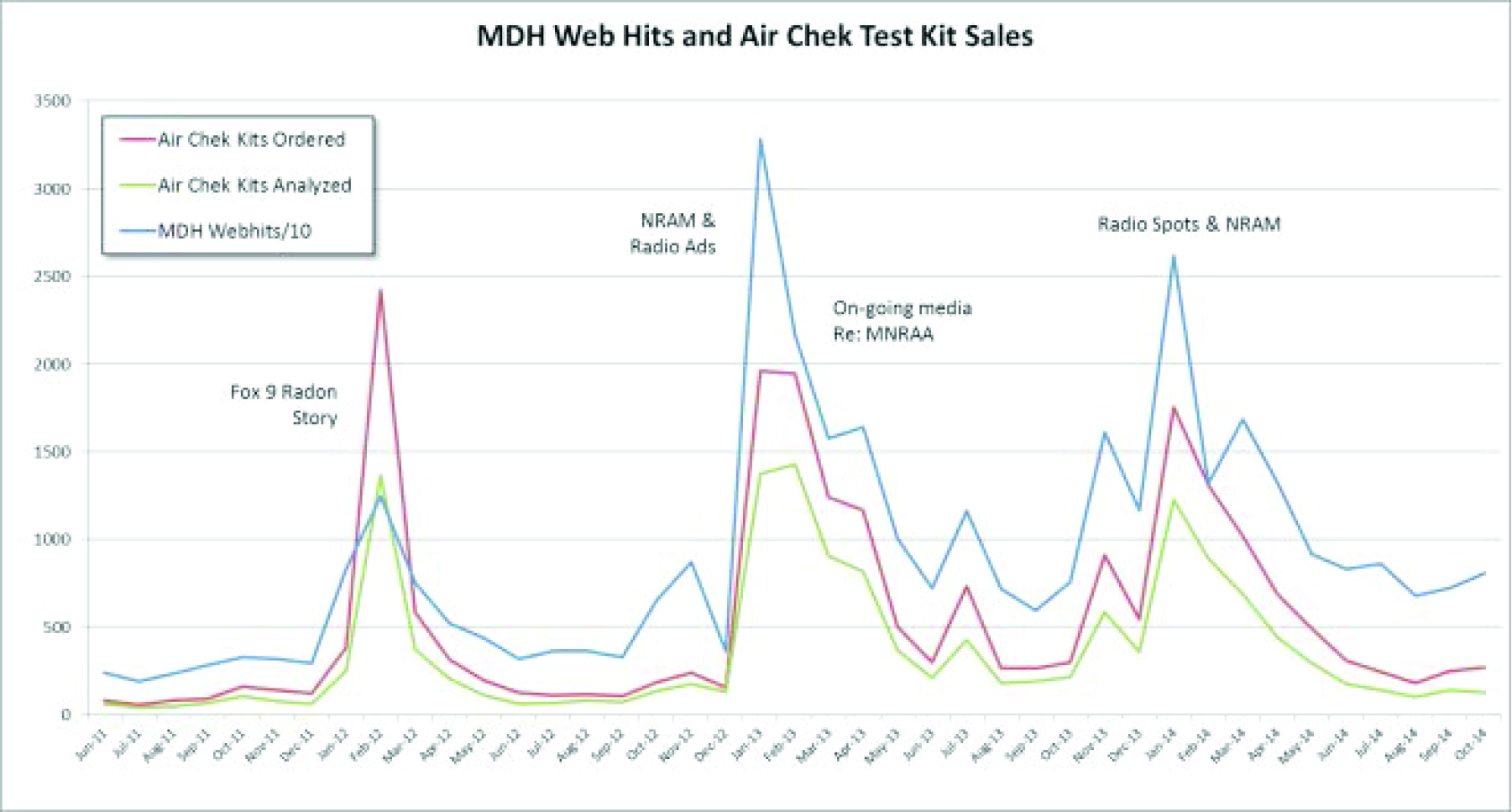
The department’s website provides detailed information about radon for the public. The number of visits to the main radon webpage are tracked and recorded as an individual page view. Charting shows the monthly page views, as well as individually purchased radon kits (purchased directly from Air Chek), from June 2011 to October 2014. (The test kits purchased directly through Air Chek are ordered at mn.radon.com.) The correlation between test kit purchased and analyzed and web hits is apparent.
Through several public and media outlets and methodologies, the Minnesota Department of Health raises awareness to the radon issues, reaching thousands of residents, and encourages testing and mitigation.
For more information, contact:
Dan Tranter, M.P.H.
Supervisor
Indoor Air Unit
P.O. Box 64975
St. Paul, MN 55164
Office: (651) 201-4618
Mobile: (651) 331-6548
Fax: (651) 201-4606
Web: www.health.state.mn.us/divs/eh/air
Radon: http://www.health.state.mn.us/divs/eh/indoorair/radon/index.html
Source:
Minnesota Department of Health
Indoor Environments & Radiation Section
Indoor Air Unity State Indoor Radon Grant 22-24 Final Report, October 1, 2011- September 30, 2014
http://www.health.state.mn.us/divs/eh/indoorair/radon/sirgreport12014.pdf
United States